Enter your text here...
After 50, Retirement Pressure Doesn’t Warn You — It Just Shrinks Your Life
Rising prices. Rising healthcare costs.
Market drops that don't fully recover.
By the time you feel it, your options are already smaller.
A few years later they're gone completely.
Groceries, utilities and fuel cost more. Insurance goes up again. And the pill you take now is the pill you'll take for the rest of your life. Then it's two pills. More visits. More tests. More out of pocket, every year.
Nothing breaks. Nothing crashes. But you feel it everywhere.
A bedroom at your daughter's house, if she's still talking to you.
Your furniture in her garage.
Asking her before you spend anything.
After a lifetime of providing. Sit in that for a second.
Nobody's ever had this conversation with you. They won't. It's too personal.
You've had it with yourself, though. At two in the morning, staring at the ceiling.
Earlier in life, time covered mistakes.
A bad year healed. Markets bounced back. After 50, the same hit changes your trajectory. And it stays changed.
These outcomes aren't driven by intelligence or effort. They're driven by whether your income still needs time to cooperate, or whether it works even when time doesn't.
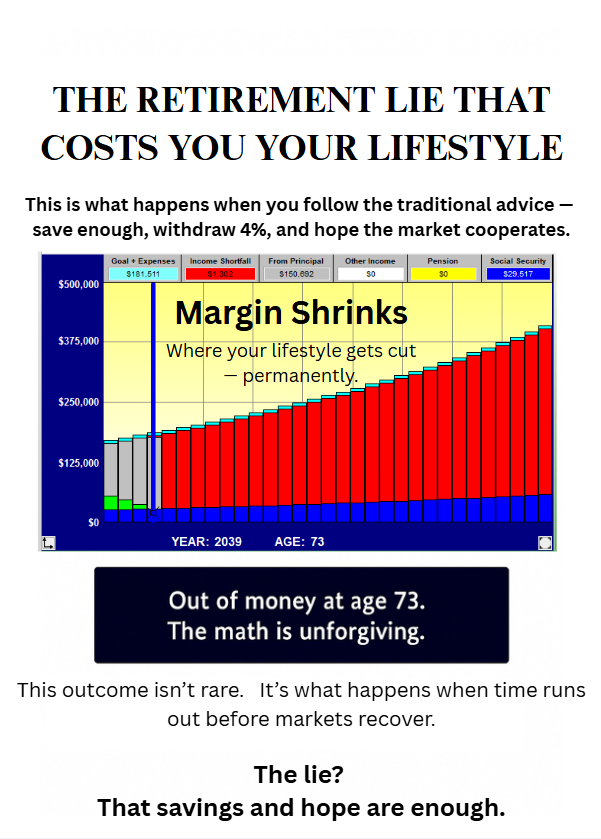
Here's what that actually looks like on paper.
Hypothetical illustration. Not a projection of individual results.
That's the standard advice on paper. Save enough, withdraw four percent, hope the market cooperates.
The red is your margin. It's where your lifestyle gets cut, and it doesn't come back.
The lie is that savings and hope are enough.
Once time is limited, structure matters more than growth.
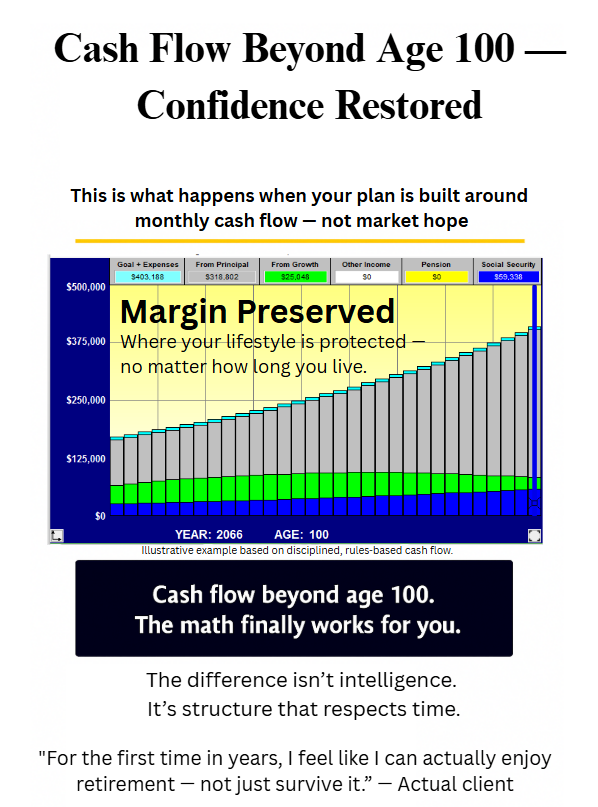
Same starting balance. Same average return. Same discipline. Two completely different endings.
Not because one of them was smarter.
Hypothetical illustration. Not a projection of individual results.
Same math. Different structure. The difference isn't intelligence. It's a structure that respects the time you actually have.
You're doing math in your head right now about your own age.
He's 84. His son is 60. The son came second.
Most traditional advice assumes you have decades.
It assumes decades to recover, a crash only every seven to ten years, and a large portfolio to draw from.
If you're over 50, you've already sat through two or three of them. You know what each one took.
If you're a late saver with less than $500K, those approaches are stacked against you.
| Strategy Type | Method | Cash Flow Potential | Risk Profile | Time to Results |
|---|---|---|---|---|
| Index Funds / Diversified Portfolios | Invest in a diversified mix of low-cost index funds, often using a stock/bond split or Target Date Fund. | Typical strategy is a "Safe Withdrawal Rate" (e.g., 4% Rule), which may provide less than $20K per year from a $500K portfolio. | Exposed to full market volatility, with no control over when crashes happen. | Slow. Designed for a 30–40 year retirement plan, not a 3–5 year catch-up window. |
| Income-Focused Investments | Focus on dividend stocks, REITs, corporate bonds, or CD/savings ladders to create regular income. | Generates predictable income, but only if you already have a large enough principal to live off the yield. | Moderate risk, with less focus on growth and more on stability. | Slow. Useful for preservation, not for rapidly closing a retirement gap. |
| Annuities / Pensions | Convert a lump sum into a guaranteed stream of income for life through fixed or immediate annuities. | Reliable monthly income, but with limited upside and little to no flexibility once you commit. | Low risk in terms of cash flow reliability, but your capital is locked up. | Immediate income, but no realistic path to significantly growing your wealth. |
| SWRP Cash-Machine System | Rules-based commodities trading system designed specifically for late savers, using a self-directed Roth IRA structure where qualified distributions are tax-free. | Aims to produce cash flow you control from a small account. Every trade since 2022, wins and losses, is posted publicly at DrRouseNow.com/trades so you can judge the real record yourself. | Risk is defined in advance on every trade, typically about 3–5% of the account, and the system runs on a small, separately funded amount so the rest of your savings stays untouched. | Designed to build a supplemental income stream you control over a short window of a few years, rather than a multi-decade plan. |
Swipe the table sideways to see all five columns.
Traditional strategies can work for people who started early and saved consistently. For late savers they're simply too slow.
Look at the first three again.
They all have the same thing in common. Each one takes something from what you've already got. More of your savings. More of your years. More of your say in how the money gets spent.
Ninety one percent of retirees say what they want is guaranteed income. Nobody wakes up at 64 wanting a guarantee. What they want is to stop lying awake doing math.
A guarantee is real. So is what you hand over to get it, and what you hand over is the right to change your mind. That money isn't available the year your daughter needs help or the roof goes.
This page is for educational purposes only and does not constitute individualized financial, investment, or legal advice. No specific investment products or services are offered or recommended. Results are not guaranteed.
© 2025 DrRouseNow.com